Minimally Invasive Discectomy vs Micro/Open Discectomy
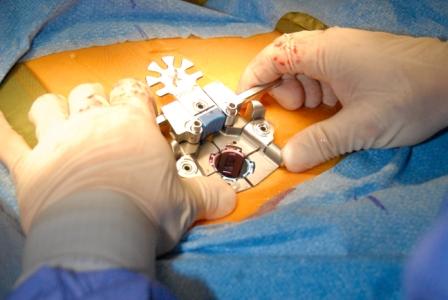
We’ve all heard of “Minimally Invasive Discectomy” as it is used as a marketing ploy almost everywhere. Everyone has a different description of what minimally invasive actually is.
Some consider MIS as surgery being done through small incisions, with less dissection, and therefore less pain, and faster recovery. With that criteria, many of the spine surgeries being done today are MIS, when compared to the techniques of the past. Not too long ago, patients were admitted to the hospital for many days, with large incisions to the back, for simple operations such as lumbar discectomy. Now, it is fairly standard for the surgery to be performed on an outpatient basis, with less than two inch incisions, and rapid return to activities
Others consider the term more important when concerning lumbar fusions. The multifidus muscle is thought to be a very important stabilizer of the spine. If the multifidus muscle is preserved, some would consider that the definition of MIS lumbar Spinal Fusion Surgery. By that criterion, the open bilateral Wiltse approach would qualify as MIS surgery, yet there will be standard incisions being used for the surgical approach.
In the end the term Minimally Invasive Surgery is an attempt to define a better, more precise, less painful way to do surgery. Unfortunately, there are also associated risks and learning curve issues with the MIS approaches. The goal for the surgeon is to have visualization of the surgical site. In the learning curve of MIS surgery, sometimes, the visual field may be obscured, and in the attempt to continue the surgery, outcomes may be compromised. In some MIS procedures, the real term should be percutaneous.
In the percutaneous techniques, needles are placed into the body, and surgery is conducted via the needles, with x-ray guidance. The surgeon never sees the actual field of surgery, but makes assumptions by the location of the needle on the X-ray/fluoroscopic image. While these techniques can be effective, the surgeon must make assumptions that the x-ray image is correctly identifying the location of the problem, as the Surgeon will never directly be able to see if the problem has been addressed.
In the end, MIS or any surgery must consider the advantages, and the risks. MIS sounds high tech, sexy, and state of the art. In my opinion, there are advantages to MIS for certain situations. But in the end, it comes down to results. That ultimately will depend on the problem, the patient, and the skill of the surgeon. With or without MIS, if the goals of the surgery has been met, there will likely be a good outcome.
Citations
- McClelland S 3rd, Goldstein JA. Minimally Invasive versus Open Spine Surgery: What Does the Best Evidence Tell Us? J Neurosci Rural Pract. 2017 Apr-Jun;8(2):194-198. PubMed PMID: 28479791
- Rasouli MR, Rahimi-Movaghar V, Shokraneh F, Moradi-Lakeh M, Chou R. Minimally invasive discectomy versus microdiscectomy/open discectomy for symptomatic lumbar disc herniation. Cochrane Database Syst Rev. 2014 Sep 4;(9):CD010328. PubMed PMID: 25184502
- Kim CW. Scientific basis of minimally invasive spine surgery: prevention of multifidus muscle injury during posterior lumbar surgery. Spine (Phila Pa 1976). 2010 Dec 15;35(26 Suppl):S281-6. PubMed PMID: 21160391
Last modified: March 9, 2018