What is a facet injection?
If you have watched our other videos, you know that the facet is the joint in the back of the spine neck and connects one bone to the other.
Over time, the facet joints can develop arthritis and developed pain. Sometimes, the facet joint can be injured and be a source of pain.
In certain situations, an injection of the medication into those facet joints can provide some pain relief.
Facet joints are typically injected with a combination of an anesthetic and a type of cortisone. If the injections are beneficial, the medications will reduce the inflammation associated with the facet joint.
The procedures performed by lying the patient down on a special x-ray table that allows a Fluoroscopic machine to take real time x-rays which are used to direct the needle into the facet joints.
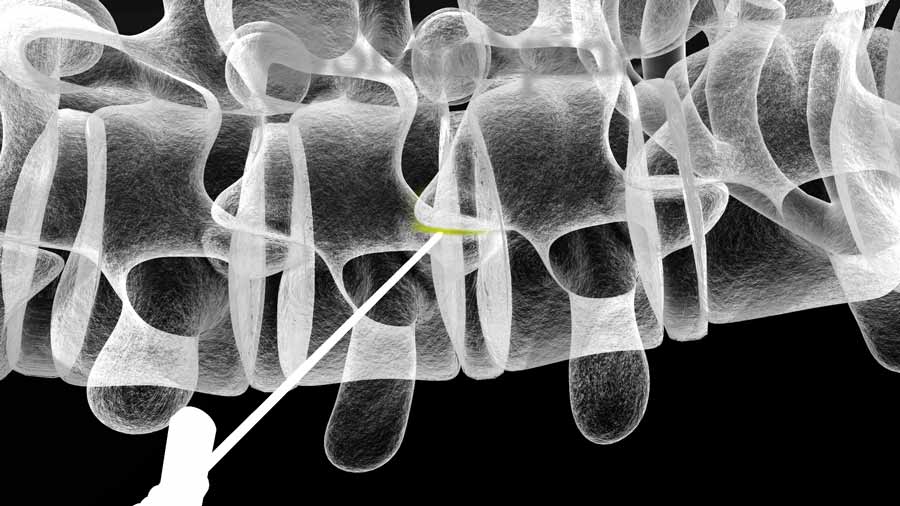
Once positioning is confirmed, (sometimes) a small amount of dye is injected into the facet joint to confirm placement. Then a small amount of anesthetic agent along with an anti-inflammatory agent is administered. The procedure is typically done without sedation although some patients can have a sedative.
If beneficial, medications will reduce the swelling associated with the facet joint. The acute flareup of pain associated with arthritis or injury will subside.
Sometimes physicians will recommend a different type of injection to relieve the pain associated with an irritated facet joint.
There are small nerves associated with the facet joints, called the medial branches of the primary ramus of the spinal nerves. These are nerves that come off the spinal cord that go to the arms and legs. There is small branch signals pain or irritation from the facet joints.
The medial branch block is an anesthetic delivered to the nerves causing them to stop registering the pain.
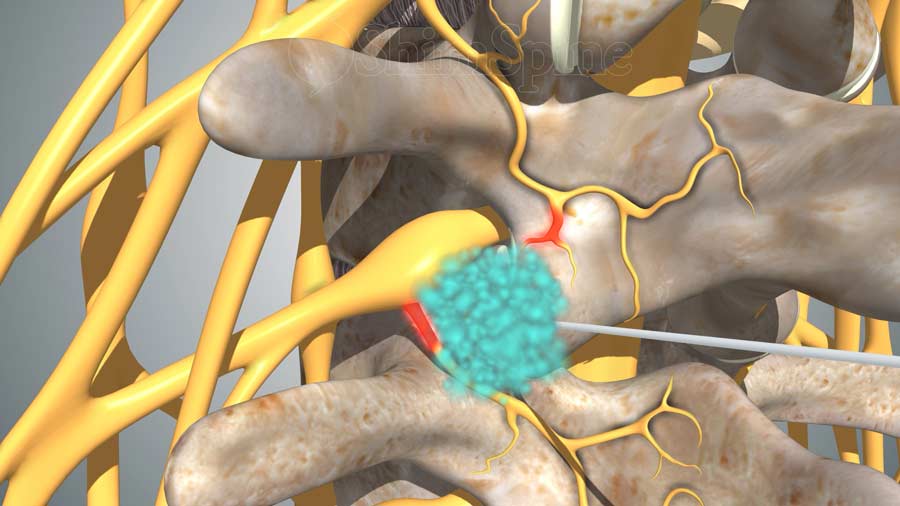
Anesthetic blocks can wear off. Some doctors will use a procedure called a radiofrequency ablation to effectively “burn” these nerves, providing a more lasting relief.
I have personally used both techniques. For selected patients, the procedure can be of benefit.
Facet injections can provide months of relief. Medial branch blocks as well. Radiofrequency ablations can provide up to a year of relief. But it does not work for all people, and it may not provide relief with repeating the process.
There is a theoretical concern about the medial branch blocks. The analogy I like to use it is that of the check engine light. If you are car engine has a problem, there is usually a warning light that signals a potential issue.
Pain is a signal indicating a potential issue. The medial branch blocks and associated radiofrequency ablations are like just removing the check engine light. While the check engine might no longer registers a problem, it does not mean the problem does not exist.
I know this is a controversial statement. Many doctors believe there is a benefit for removing this check engine light to eliminate pain. But Doctors also know the pain signals can be necessary to prevent overuse of the painful body part. In a car, if you do not investigate the reason for the check engine light, you might be delaying repair of the engine. Are we doing the same for the spine with these medial branch blocks? So far there has not been enough data to suggest there are long-term ramifications to these medial branch blocks and ablations. But time will tell.
If you would like more information about similar topics, please subscribe to our newsletter or our YouTube channel .
Last modified: March 27, 2020