Cycling and Back Pain
In this video/blog, we’ll be taking a look at the relationship between back pain and cycling.
Unfortunately, despite cycling being a low-impact sport, back pain is the most common injury reported by cyclists. One Norweigian study showed 40% of all cyclists seeking medical attention for back pain.
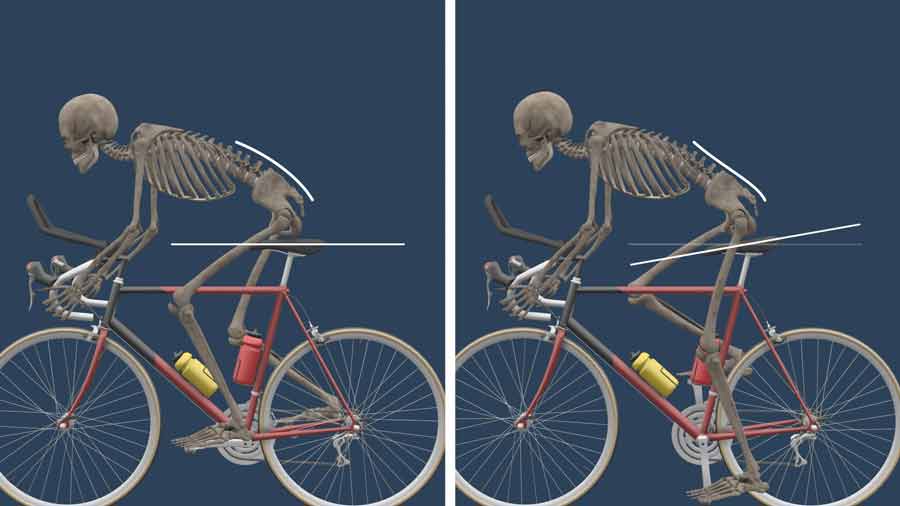
The primary culprit appears to be muscle fatigue resulting in overuse injuries. Scientists demonstrated that as cyclists exhausted their energy, their hamstrings and calf muscles became progressively more fatigued. While this isn’t surprising in itself, what is surprising is the following cascade of undesirable changes your body undergoes. The resulting changes in muscle movement patterns paralleled changes in the degree to which cyclists were bent forward in the lumbar region and how far their knees were spread.
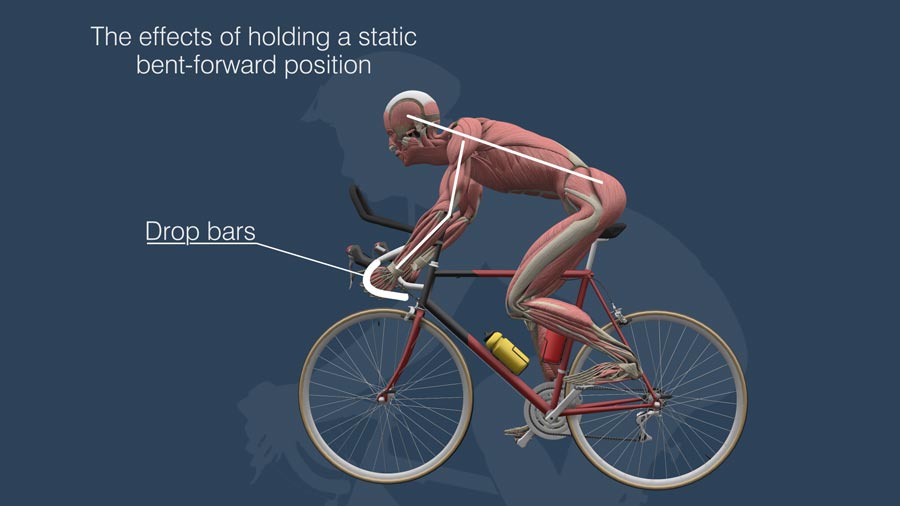
A study examined the effects of holding a static bent-forward (flexion) position on the back extensor muscles that play an important role in maintaining good posture and stabilizing the lower back. When a cyclist is in this position (also referred to as on the drops), they are able to lower their center of gravity allowing them to lean farther to either side for better cornering. Holding this position for an extended period of time causes the extensor muscles to become fatigued and less effective at maintaining spinal stability and posture.
A common finding across several studies is that cyclists who were suffering from chronic low back pain had a tendency to ride with more flexion in their lower lumbar spine than their non-back pain counterparts.
Like all athletes, cyclists must take care of their bodies and strike a delicate balance between pushing their body and allowing it to recover and heal. To prevent the negative effects of impaired movement patterns, cyclists should do exercises that strengthen the muscles in their lower back and core.
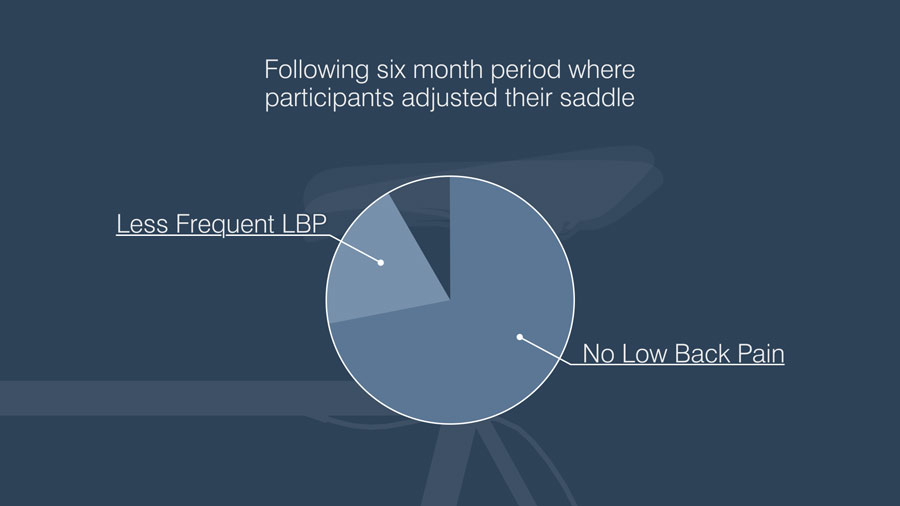
Make sure the bike fit is appropriate for your size and riding needs: choosing a frame with the right geometry will help minimize unwanted stress on your lower back, knees, shoulders, and neck. The next step is to optimize your bike setup including the saddle height, saddle angle, and handlebar position to limit the amount of force being loaded on the spine while cycling. Although there aren’t any studies showing definitive relationships between the positions of the saddle and handlebar and low back pain, the general rule of thumb is the less stress and discomfort your body is suffering the better.
Multiple studies show that the greatest correlation for low back pain is the duration of cycling. Cyclists who cycle an average of 100 miles per week were found to have significantly higher rates of low back pain.
As with most injuries, if your back pain doesn’t get better with rest and treatment at home on its own, you should consult your doctor. Overuse injuries are very common with cyclists because of the long, grueling hours they spend on the saddle at a time.
I hope this provided some insight on the relationship between cycling and back pain. Thanks for reading and until next time, this is Dr. Shim.
Additional Resources:
https://www.cyclingweekly.com/fitness/lower-back-pain-dont-blame-the-bike-32094
Citations
- Schultz SJ, Gordon SJ. Recreational cyclists: The relationship between low back pain and training characteristics. Int J Exerc Sci. 2010;3(3):79-85. PubMed PMID: 27182332
- Schulz SJ, Gordon SJ. Riding position and lumbar spine angle in recreational cyclists: A pilot study. Int J Exerc Sci. 2010;3(4):174-181. PubMed PMID: 27182345
Last modified: May 27, 2021









Thank you for the article, you are an inspiration to us all . Heres a great way i found to Helps Morning Ritual
Keeps Your Back Pain-Free. Yes, There IS Hope for, Simple 30-second Morning Ritual Keeps Your Back Pain-Free All Day
I hope it helps some other! watch your free video testimonial https://bit.ly/3fLxikr , its a bit of a long training but the good stuff is about 10min in.