After the Crash: What You Need to Know About Spine Injuries and Auto Accidents
Motor vehicle accidents are one of the most common causes of acute spine injuries in the United States. Each year, millions of Americans experience neck or back pain following a collision. Navigating the medical, legal, and insurance landscape after an accident can be confusing and stressful. This post provides a factual overview of what typically occurs, what documentation matters, and what both injured individuals and evaluating physicians should understand.
The Biomechanics of the Accident
The spine is vulnerable in rear-end collisions, where the head and neck undergo rapid acceleration-deceleration, the mechanism commonly associated with cervical whiplash. The forces involved can strain or tear ligaments, tendons, and muscles. The latest MVA accident data analysis showed that herniated discs are rare. Low-speed collisions can still cause soft-tissue injury despite minimal vehicle damage, and, conversely, high-speed collisions do not always result in serious spinal injury. Vehicle damage alone is not a reliable predictor of occupant injury severity.
Steps to Take After an Auto Accident
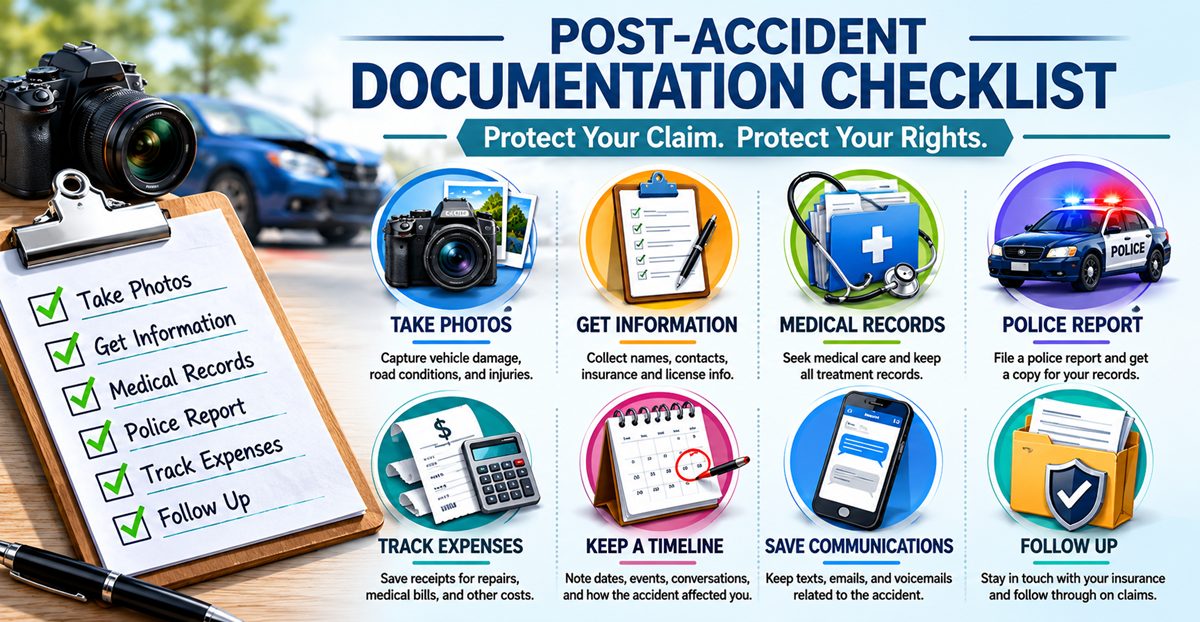
From a medical and documentation standpoint, the following steps are important regardless of whether a legal claim is anticipated:
- If you experience more than mild pain, or if the pain increases rapidly, seek prompt medical evaluation: Delayed onset of pain is common with soft tissue injuries and cervical strains. Even if symptoms seem mild initially, have a physician assess you within 24-72 hours of the accident if you are concerned.
- Document everything: Keep a written log of your symptoms, their onset, progression, and any activities they affect. Photograph any visible injuries.
- Follow through with the recommended treatment: Consistency in medical care is important for both your recovery and establishing an accurate medical record. Gaps in treatment can complicate both clinical and legal evaluations.
- Preserve accident-related records: This includes the police report, vehicle photos, witness information, and any communications with insurance companies.
- Communicate openly with your medical providers: Be thorough and accurate when describing where and how you hurt. Medical records are foundational documents in any subsequent legal evaluation.
Understanding the Medical-Legal Evaluation
When a dispute arises, whether through an insurance claim or civil litigation, a medical-legal evaluation (in Florida, it is called an Examination of Persons, or a Compulsory Medical Evaluation) may be requested. These evaluations are performed by physician specialists to provide an objective opinion on causation, diagnosis, extent of injury, and appropriate treatment. It is important to understand that a CME physician does not have a treating relationship with the examinee, and the examination is intended to be objective and impartial.
From the injured person’s perspective: be truthful, thorough, and consistent. Exaggerating symptoms can undermine credibility and harm your case. From the requesting party’s perspective: the goal of a fair CME is objectivity, not a predetermined outcome. Courts and insurers alike benefit most from accurate, unbiased medical opinions.
Pre-Existing Conditions and the Aggravation Doctrine
A common source of legal and medical debate involves pre-existing spine conditions. Many adults over 40 have asymptomatic degenerative changes visible on MRI, disc bulges, facet arthritis, or mild stenosis that caused no symptoms prior to an accident. In most jurisdictions, the legal principle known as the ‘eggshell plaintiff’ or aggravation doctrine holds that a defendant may be liable for aggravating a pre-existing condition, even if that condition made the plaintiff more susceptible to injury. The clinical question, and the medical expert’s role is to distinguish pre-existing pathology from new injury, and to assess whether the accident substantially contributed to the patient’s current condition.
Spine Disability After a Motor Vehicle Accident
Disability determinations after spine injuries are complex and depend on objective clinical findings, imaging, functional assessments, and sometimes vocational evaluations. Persistent radiculopathy, disc herniation requiring surgery, or instability from ligamentous injury may support a finding of partial or total disability. It is worth noting that subjective pain reports alone, without corroborating objective findings, present a more difficult case for establishing disability under most insurance and workers’ compensation frameworks.
Whether you are a patient, an attorney, or a claims professional, understanding the medical facts clearly is the first step toward a fair outcome for everyone involved. Until next time, this is Dr. Shim.
References
Kent R, Cormier J, McMurry TL, et al. Spinal injury rates and specific causation in motor vehicle collisions. Accid Anal Prev. 2023;186:107047. doi:10.1016/j.aap.2023.107047
Elliott JM, Walton DM, Albin SR, et al. Biopsychosocial sequelae and recovery trajectories from whiplash injury following a motor vehicle collision. Spine J. 2023;23(7):1028–1036. doi:10.1016/j.spinee.2023.03.005. PMID: 36958668
Kus B, Yilmaz G, Hancer Celik F, et al. Acute cervical intervertebral disc herniation after traffic accident: the importance of rapid diagnosis with MRI in the emergency department. Northwestern Med J. 2025;5(4):274–280. doi:10.54307/NWMJ.2025.155
van Den Hauwe L, Sundgren PC, Flanders AE. Spinal Trauma and Spinal Cord Injury (SCI). In: Diseases of the Brain, Head and Neck, Spine 2024–2027: Diagnostic Imaging. NCBI Bookshelf. Updated February 2024. NBK608594.
Disclosure: This blog is for general educational and informational purposes only. It does not constitute legal or medical advice. Dr. Shim provides opinions as an experienced orthopaedic spine surgeon with medical-legal expertise since 1994. This content is presented without bias toward plaintiff or defendant interests. ShimSpine.com is self-funded and accepts no paid advertising.
Last modified: June 11, 2026