Engineered for Survival: How 60 Years of Vehicle Safety Advances Changed Spine Injuries After Rear-End Crashes
Today, I want to talk about something that comes up often in my practice: how dramatically the nature of spine injuries from rear-end car crashes has changed since I started practicing in the early 1990s, and how much further back the real transformation began.
When people picture a “whiplash injury,” they often imagine the same crash mechanics their parents or grandparents described. But the vehicles involved, and the injuries that result, are quite different today. Understanding why matters for patients, treating physicians, and anyone evaluating a spine injury claim.
The 1960s Baseline
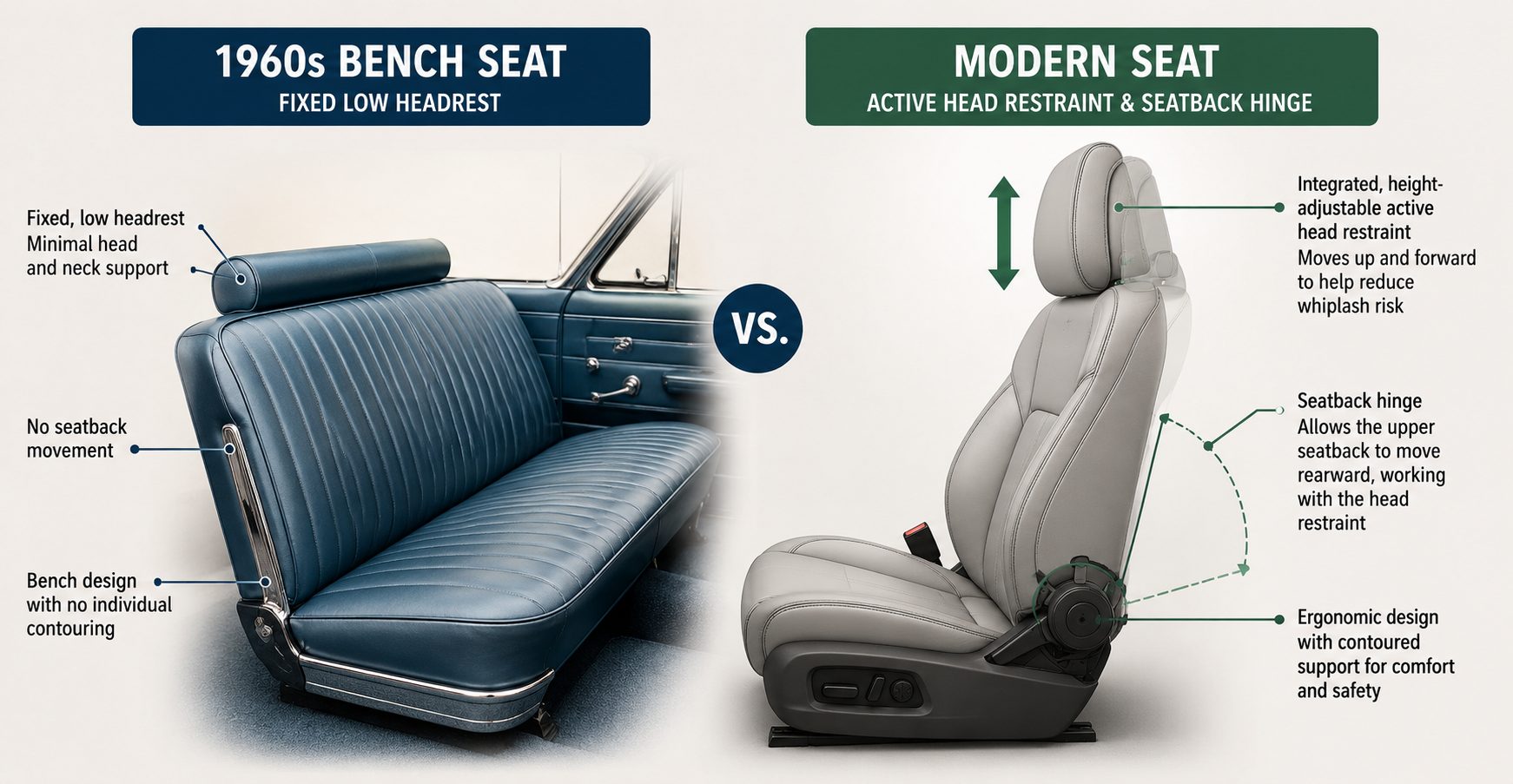
In the early 1960s, most American cars had no headrests, lap-only seatbelts (if any), rigid steering columns, and seatbacks that were prone to collapsing rearward under load. In a rear-end collision, an occupant’s head could snap backward with nothing to limit its travel, and the seatback itself sometimes failed, allowing the occupant to be thrown into the rear seat. Cervical spine fracture-dislocations, traumatic disc herniations with neurological deficit, and severe ligamentous injuries from uncontrolled head and torso motion were not uncommon in even moderate-speed impacts.
Five Decades of Engineering Progress
Several incremental changes reshaped this picture. Three-point seatbelts, first introduced by Volvo in 1959 and mandated broadly through the 1960s and 1970s, kept occupants positioned in the seat rather than allowing free movement toward the dashboard or rearward into the seatback. Crumple zones, developed in the 1950s and refined for decades after, allowed the vehicle’s frame to absorb crash energy before it reached the occupant compartment. Head restraints, first patented in 1921 but not widely required until the 1960s and 1970s, gave the head something to rest against during a rear impact. Beginning in the late 1990s and 2000s, “active” head restraint and seatback systems, such as Volvo’s WHIPS and Saab’s active head restraint, went further, moving the head restraint forward and the seatback rearward simultaneously to cradle the head and torso together. Published research on these systems has reported reductions in whiplash-type neck injury claims ranging from roughly 20 to over 50 percent compared with conventional seats.
Injuries Rarely Seen Today
As a result, certain injury patterns that were once a regular part of spine practice, seatback failure injuries, severe cervical fracture-dislocations from low-to-moderate speed rear impacts, and high-grade ligamentous instability from unrestrained head motion, are now uncommon in modern, well-maintained vehicles with functioning restraint systems. What remains far more common is the soft-tissue cervical and lumbar strain pattern, sometimes with disc-level findings on imaging that may or may not be causally related to the crash itself.
What This Means for Evaluation Today
For treating physicians and for those reviewing spine injury claims, vehicle generation, restraint system design, and seat performance are all relevant pieces of context. The same described mechanism of injury can carry very different biomechanical implications depending on whether the vehicle involved had a 1960s-era bench seat or a modern active head restraint system. People love their classic cars, but few understand the safety changes that have become standard in modern automobiles.
Until next time, this is Dr. Shim.
References
- National Highway Traffic Safety Administration. History of seatbelt and occupant protection regulations.
- Volvo Car Corporation / Jakobsson L, et al. The Effectiveness of Active Head Restraint in Preventing Whiplash. Traffic Injury Prevention.
- Society of Motor Manufacturers and Traders (SMMT). A Brief History of Car Safety: Seatbelts, Crumple Zones & Airbags.
- Farmer CM, et al. Effects of Head Restraint and Seat Redesign on Neck Injury Risk in Rear-End Crashes. Insurance Institute for Highway Safety.
- Frontiers in Bioengineering and Biotechnology (2026). A multimodal approach for assessing the risk of cervical spine injury in low-speed rear-end collisions.
This blog is intended for general educational purposes only and does not constitute medical or legal advice. Always consult a qualified spine specialist or attorney regarding your specific situation.
Last modified: June 11, 2026