Why an Evaluation for Pain After a Minor Auto Accident May Differ From an Evaluation for Everyday Pain
Today, I want to talk about something that comes up often in my practice: why a medical evaluation for back or neck pain after a car accident can look and feel different from an evaluation for pain that develops from everyday life, like gardening, lifting at work, or simply waking up stiff. The underlying spine may be exactly the same. But the way the evaluation is approached, documented, and timed often is not, and there are practical reasons for that.
Why Context Changes the Evaluation
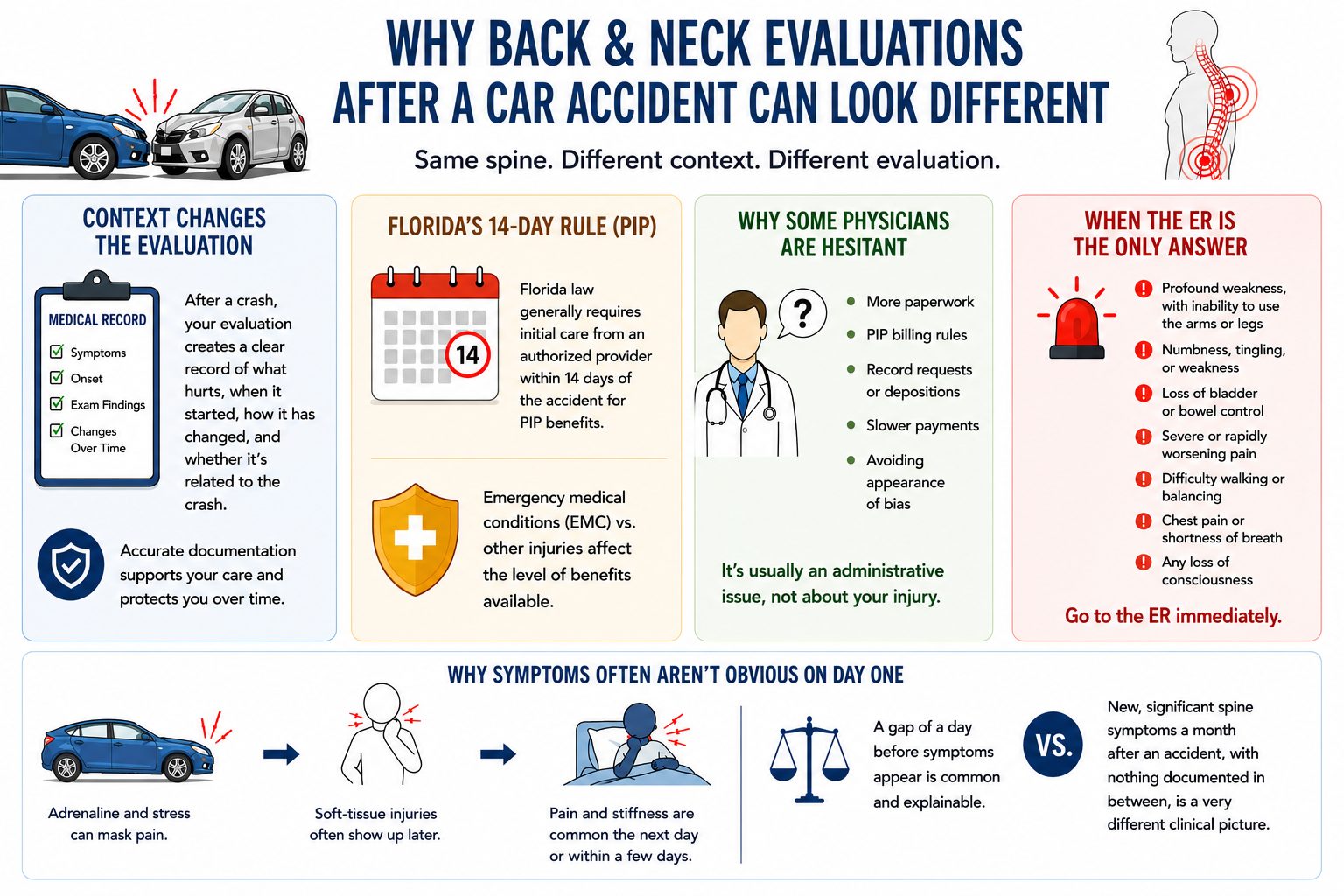
When someone comes to me with neck or back pain that built up gradually, the visit is usually straightforward; a history, exam, imaging if indicated, and a treatment plan. After a motor vehicle collision, even a low-speed one, the evaluation often needs to do double duty. It still has to identify and treat the injury, but it also has to create a clear, contemporaneous record: what hurts, when it started, how it has changed, and whether it is plausibly related to the crash mechanics. That second layer of documentation isn’t about assigning blame, it’s about creating an accurate medical record that holds up over time, for the patient’s own care as much as for any later questions about the injury.
Florida’s Documentation Requirements
Florida’s no-fault auto insurance law adds a real-world deadline to this picture. Under the state’s Personal Injury Protection (PIP) statute, an injured person generally must receive initial services and care from an authorized provider within 14 days of the accident for PIP benefits to apply. Florida law also distinguishes between an “emergency medical condition” (EMC) and other injuries and that determination affects the level of PIP benefits available. In practice, this means the timing and content of that first medical visit carry weight well beyond the exam room. A visit that happens promptly, and that documents symptoms in the patient’s own words along with objective findings, tends to create a much clearer record than one that happens weeks later after symptoms have already been filtered through memory.
Why Some Physicians Are Hesitant to Get Involved
Patients sometimes tell me they called several offices after an accident and were told the practice “doesn’t see auto cases.” This is a common frustration, and it has less to do with the patient and more to do with administrative reality. Auto-injury cases often involve additional paperwork, PIP billing and documentation requirements that differ from standard health insurance, the possibility of being asked for medical records or a deposition months or years later, and payment timelines that can be slower than commercial insurance. Some practices simply aren’t staffed for that administrative load, and others prefer to avoid any appearance of taking a side in a claim. None of this reflects on the legitimacy of the patient’s injury, it’s a structural issue, and one reason urgent care centers, hospital-based providers, and practices that specifically work with PIP cases often become the practical first stop.
When the Answer Is the Emergency Room — No Exceptions
Separate from any documentation or insurance question, certain symptoms after a crash require emergency evaluation, full stop. These include new numbness, tingling, or weakness in an arm or leg; loss of bladder or bowel control; severe or rapidly worsening pain; difficulty walking or maintaining balance; chest pain or shortness of breath; or any loss of consciousness. These can signal spinal cord involvement, fracture, internal injury, or other limb- or life-threatening conditions, and they need to be evaluated immediately in an emergency department, and not at a follow-up appointment scheduled for later in the week.
Why Symptoms Often Aren’t Obvious on Day One
One pattern I see often: a person feels “okay” at the scene, declines transport, and then wakes up the next morning with significant neck or back pain and stiffness. This can be explained physiologically; adrenaline and the body’s acute stress response can mask pain in the first few hours, and soft-tissue injury (muscles, ligaments, discs) frequently becomes more apparent over the following one to three days as inflammation develops. The important point is the timeline: meaningful new or worsening symptoms typically emerge within the first few days after a collision, not weeks or months later. A gap of a day before symptoms become noticeable is common and medically explainable. A new onset of significant spine symptoms a month after an accident, with nothing documented in between, is a very different clinical picture and is harder to evaluate retrospectively. This is exactly why getting evaluated promptly, and describing all symptoms, even mild ones, at that first visit matters both for treatment and for an accurate medical record.
Until next time, this is Dr. Shim.
References
- Florida Statutes § 627.736 — Required Personal Injury Protection Benefits; Required Benefits.
- Florida Statutes § 627.732 — Definitions; “Emergency Medical Condition.”
- Quinlan KP, Annest JL, Myers B, et al. Neck strains and sprains among motor vehicle occupants — United States, 2000. Accid Anal Prev. 2004;36(1):21-27.
- Carroll LJ, Holm LW, Hogg-Johnson S, et al. Course and prognostic factors for neck pain in whiplash-associated disorders. Spine. 2008;33(4S):S83-S92.
- American College of Emergency Physicians. Clinical Policy: Critical Issues in the Evaluation and Management of Adult Patients Presenting to the Emergency Department with Acute Blunt Trauma. Ann Emerg Med. 2023.
- National Highway Traffic Safety Administration (NHTSA). Crash Injury Research — Delayed Onset of Symptoms After Motor Vehicle Crashes.
- Spitzer WO, Skovron ML, Salmi LR, et al. Scientific monograph of the Quebec Task Force on Whiplash-Associated Disorders. Spine. 1995;20(8 Suppl):1S-73S.
This blog is intended for general educational purposes only and does not constitute medical or legal advice. It presents no bias toward plaintiffs or defendants. Always consult a qualified physician for evaluation of any new or worsening symptoms, and seek emergency care immediately for limb- or life-threatening conditions.
Last modified: June 12, 2026