Why a More Optimistic Surgeon Can Face Greater Risk Than an Aggressive One
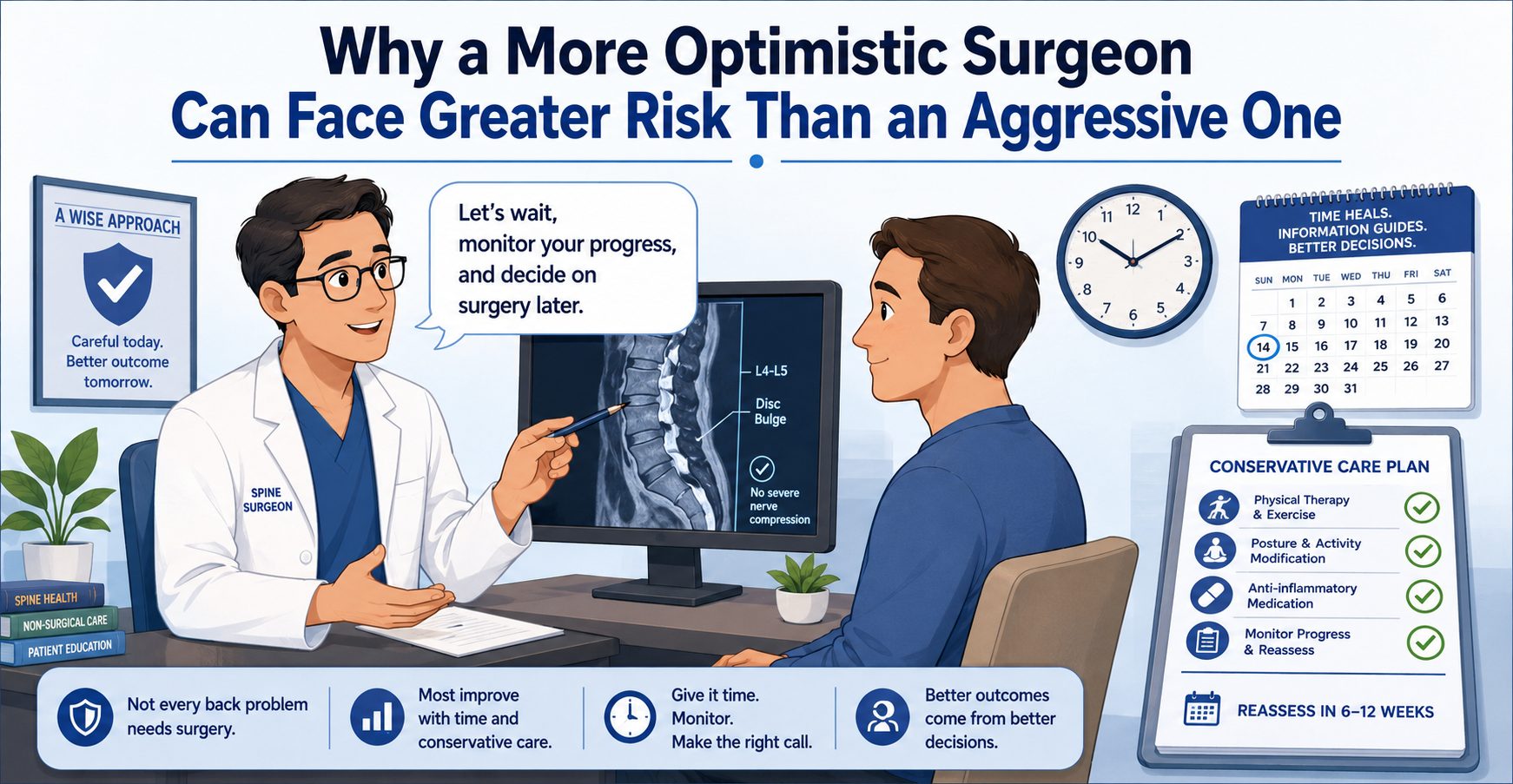
It may seem counterintuitive, but the spine surgeon who tells you “you probably don’t need surgery” can actually be taking on more professional risk than the surgeon who recommends operating right away. After more than 30 years practicing orthopaedic spine surgery in the Tampa Bay area, this is a pattern I have seen consistently, and it is one that patients deserve to understand.
The Honest Truth About Most Spine Conditions
For most non-cancerous, non-infectious spine conditions- think herniated discs, degenerative arthritis, spinal stenosis, and even many cases of nerve compression- the medical literature is clear: the majority of patients improve without surgery. This is what we call the “natural history” of these conditions, and it is genuinely favorable for most people.
When I see patients for second opinions, I try to share this good news. Surgery may be within the standard of care, meaning it would be reasonable and defensible, but that does not automatically mean it is necessary right now, or even at all. An optimistic, evidence-based recommendation to pursue conservative treatment first is often the most medically sound advice based on the situation.
So Why Does the Conservative Surgeon Carry More Risk?
Here is where the system creates a paradox that most patients never see.
When a surgeon recommends early surgery, and that surgery goes reasonably well, the outcome is predictable, and the relationship is straightforward. But when a surgeon recommends a non-surgical path, which is statistically more likely to succeed, several things can go wrong professionally, even when the clinical judgment was correct.
The Patient Who Eventually Needs Surgery
No medical recommendation comes with a guarantee. A small but real percentage of patients who are reasonably managed without surgery will eventually need an operation. When that happens, the patient often feels that the conservative surgeon “was wrong,” even when the non-surgical recommendation was scientifically sound for most people in the same situation.
Worse, if the patient develops a neurological problem such as new weakness, loss of bladder or bowel control, or progressive difficulty walking during the observation period, the legal and reputational exposure for the conservative surgeon can be significant, even if the recommendation to wait was fully justified at the time it was made.
Reputation, Referrals, and Revenue
The business pressures are just as real. Surgical practices generate revenue through operations. A surgeon who consistently steers patients away from surgery, even for the right reasons, may see reduced case volume, fewer OR block time allocations, and a gradual shift in the referral patterns from primary care physicians who associate a conservative surgeon with “bad outcomes” when patients eventually need surgery elsewhere.
The patient who was told to wait may later have surgery at another practice, and not by the original surgeon. That surgeon loses both the patient relationship and the clinical credit for the months of appropriate conservative care that preceded the operation.
What Protects the Patient, and the Surgeon
The answer is not to recommend more surgery. The answer is transparency, documentation, and a clear safety plan. When I recommended a conservative approach, I explained the natural history statistics, identified the specific warning signs that would require prompt return, and set defined follow-up intervals. Patients who understood the minority risk and knew exactly what to watch for were far better protected than those given simple reassurance.
This is also what protects surgeons legally and professionally. An optimistic recommendation without a documented follow-up structure is a liability. An optimistic recommendation with a clearly communicated, evidence-based safety net is both ethical and defensible.
The Bottom Line
Trying to reduce unnecessary surgery is the right thing to do for patients. But the system does not always reward that choice. As a patient, knowing this helps you appreciate that a surgeon who tells you to wait is often taking a professional risk on your behalf, because the evidence says it is the right call for most people like you. Ask your surgeon what warning signs to watch for, when you will be re-evaluated, and what would change the recommendation. That conversation is not just reassuring. It may be the most important protection you have.
Dr. John H. Shim, MD, FAAOS is a board-certified orthopaedic spine surgery Consultant in Oldsmar, Florida since 1993. ShimSpine.com specializes in second opinions and unbiased spine evaluations.
Last modified: June 22, 2026