Returning to Work After a Spine Injury: Where Medicine and Law Intersect
DISCLAIMER: This blog is for general educational purposes only. It does not constitute legal or medical advice and presents no bias toward plaintiffs or defendants.
Today, I want to talk about a question I hear constantly from patients, employers, and attorneys alike: when and how does someone return to work after a spinal injury? The medical and legal answers are related but not the same, and confusion between the two is one of the most common sources of frustration in spine injury claims. Understanding both perspectives helps everyone involved set realistic expectations.
The Medical Perspective: Healing Timelines and Maximum Medical Improvement
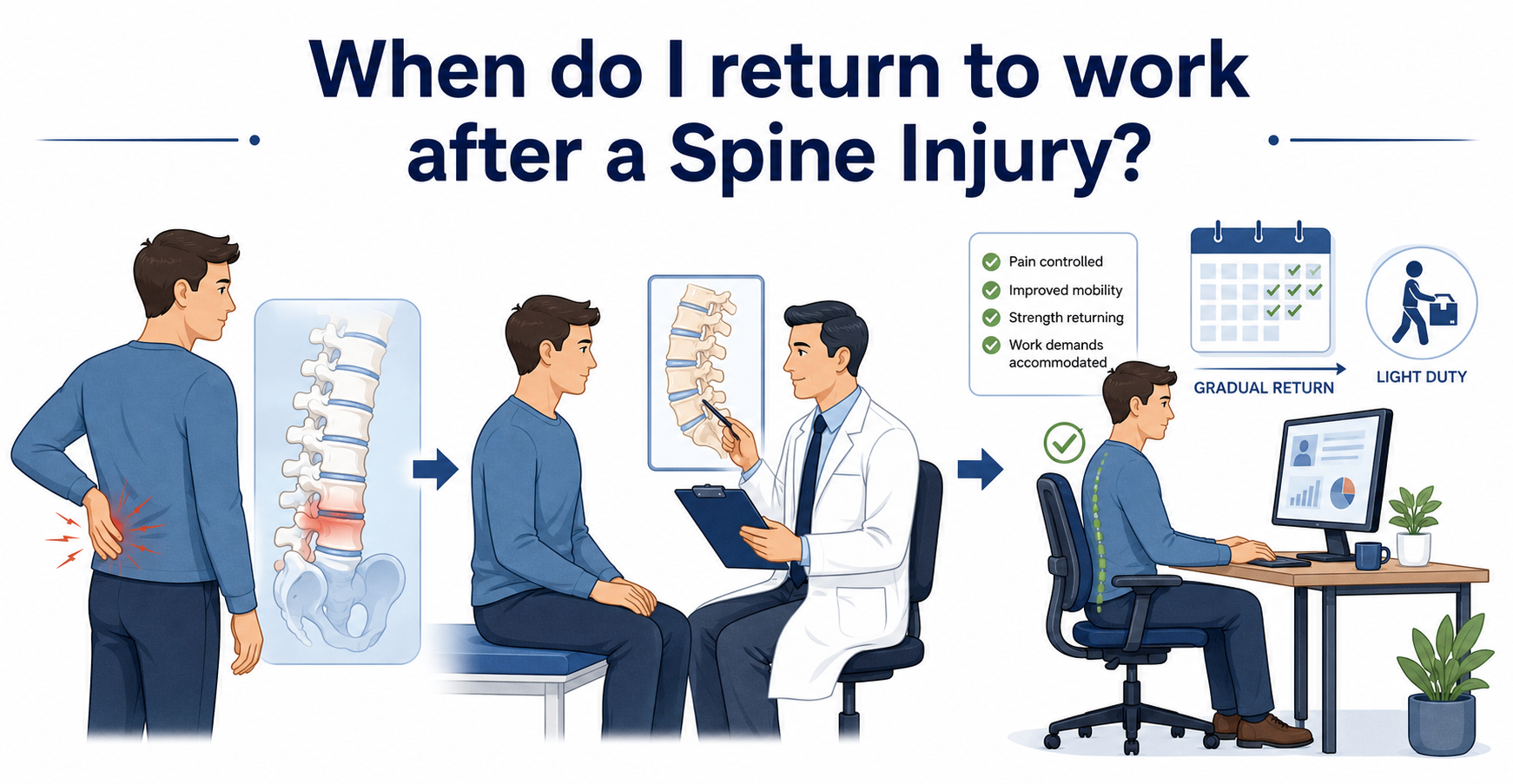
From a medical standpoint, return to work is tied to tissue healing, pain control, and functional recovery. Recovery timelines vary widely depending on whether the injury was treated conservatively (physical therapy, medication, injections) or surgically. Soft tissue strains may resolve in weeks; a fusion surgery often requires several months before a physician clears a patient for heavier physical demands. Physicians track progress toward a point called Maximum Medical Improvement (MMI), the stage at which a condition has stabilized and further recovery is not expected. MMI does not always mean full recovery; it means the condition is no longer expected to meaningfully change with additional treatment.
Work Restrictions and Functional Capacity
Before and after MMI, treating physicians typically issue work restrictions, limits on lifting, bending, sitting, or standing tolerance. These restrictions may be formed by a Functional Capacity Evaluation (FCE), a structured assessment of physical capabilities performed by a trained evaluator. Restrictions can be temporary (expected to improve) or permanent (expected to remain indefinitely), and this distinction matters greatly for both treatment planning and any related claim.
The Legal Perspective: Employer Obligations and Claim Status
Legally, return to work intersects with several frameworks. Workers’ compensation systems generally require documented medical clearance before an employee resumes duties, and many employers offer modified or light-duty positions consistent with restrictions. The Americans with Disabilities Act (ADA) may require employers to consider reasonable accommodations for qualifying conditions. In litigation contexts, an inability to return to prior work or a need for a different type of work altogether can factor into damage calculations, including claims for lost earning capacity.
When Medical and Legal Timelines Diverge
It is common for medical clearance and claim resolution to proceed on different schedules. A patient may reach MMI medically while a legal claim remains open for months afterward, or an attorney may need clarification on whether restrictions are temporary or permanent before a case can be evaluated. Clear, consistent medical documentation, including objective findings, specific restrictions, and their expected duration, is what allows both systems to function without unnecessary delay or dispute.
Until next time, this is Dr. Shim.
References
- American Medical Association. Guides to the Evaluation of Permanent Impairment, 6th Edition. AMA Press.
- U.S. Equal Employment Opportunity Commission. “The Americans with Disabilities Act: A Primer for Small Business.” eeoc.gov.
- Talmage JB, Melhorn JM, Hyman MH, eds. AMA Guides to the Evaluation of Work Ability and Return to Work, 2nd Edition. American Medical Association, 2011.
- Florida Division of Workers’ Compensation. “Employee Information Handbook.” myfloridacfo.com.
- Gatchel RJ, Neblett R. “Field of Functional Restoration: An Interdisciplinary Approach for Spine Pain.” APA Handbook of Clinical Health Psychology, 2018.
- North American Spine Society. “Evidence-Based Clinical Guidelines for Multidisciplinary Spine Care.” spine.org.
- Social Security Administration. “Disability Evaluation Under Social Security — Musculoskeletal System.” ssa.gov.
Disclosure: Dr. John H. Shim, MD is a board-certified orthopaedic spine surgeon practicing in the Tampa Bay area since 1993. This post is provided for general educational purposes, reflects no bias toward any party in a legal proceeding,
Last modified: August 21, 2026