Hydration and Your Spinal Discs: Why Water Matters for Your Back
Today, I want to talk about something simple that most of my patients never connect to their back pain: water. Here in the Tampa Bay area, July heat is no joke. We sweat, we lose fluid, and many of us do not replace it. What you may not realize is that your spinal discs depend on water to do their job. Let me explain why staying hydrated is one of the easiest things you can do for your spine.
Your Discs Are Mostly Water
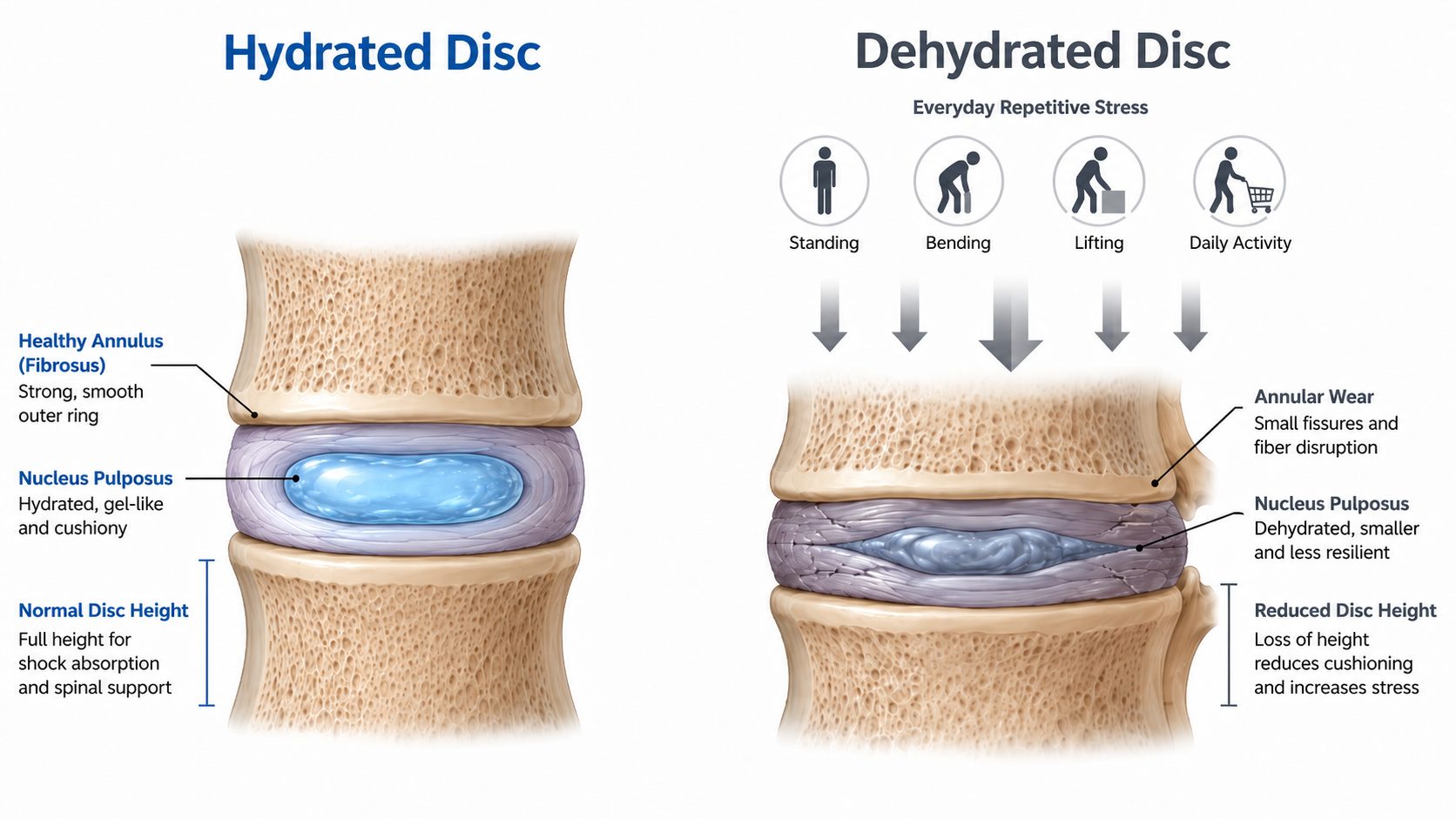
The discs between your vertebrae act as shock absorbers. Each disc has a tough outer ring called the annulus fibrosus and a gel-like center called the nucleus pulposus. That gel center is roughly 70 to 90 percent water in a healthy young adult. Water content is what gives the disc its height and its ability to cushion the loads of daily life. As we age, discs naturally lose water content, which is part of why degenerative disc changes show up on nearly everyone’s MRI over time.
Discs Lose and Regain Water Every Day
Here is something interesting: you are actually taller in the morning than at night. During the day, gravity and activity slowly squeeze fluid out of your discs. At night, when you lie down, the discs rehydrate and regain height. Researchers have measured daily height changes of 15 to 20 millimeters from this cycle. Discs have a poor blood supply, so they rely on this fluid exchange, driven by movement and pressure changes, to receive nutrition. Chronic dehydration can make this daily recovery less efficient.
Dehydration, Heat, and Back Symptoms
When you are dehydrated, your whole musculoskeletal system feels it. Muscles fatigue faster and are more prone to cramping and spasm, including the muscles that support your spine. In Florida summers, outdoor workers, golfers, and weekend gardeners can lose a surprising amount of fluid in a single afternoon. I often see patients whose back stiffness and muscle spasms flare during the hottest months, and poor hydration is frequently part of the picture.
Practical Hydration Tips for Spine Health
My advice is practical, not complicated. Drink water steadily throughout the day rather than all at once. A common guideline from the National Academies is roughly 15.5 cups of total daily fluids for men and 11.5 cups for women, with more needed in heat or during exercise. Check your urine color; pale yellow generally means you are doing well. Limit excessive caffeine and alcohol, which promote fluid loss. Keep moving, because gentle activity like walking helps pump nutrients into your discs. And if you work or play outside in our summer heat, take shade breaks and drink before you feel thirsty.
When to See a Doctor
Hydration helps, but it is not a cure-all. If you have back pain that persists beyond a few weeks, pain that radiates down a leg, numbness, weakness, or any changes in bowel or bladder function, see a spine specialist promptly. Those symptoms deserve a proper evaluation, not just another glass of water.
This summer, keep that water bottle handy. Your discs will thank you. Until next time, this is Dr. Shim.
References
- Urban JP, Roberts S. Degeneration of the intervertebral disc. Arthritis Res Ther. 2003;5(3):120-130.
- Adams MA, Roughley PJ. What is intervertebral disc degeneration, and what causes it? Spine. 2006;31(18):2151-2161.
- Reilly T, Tyrrell A, Troup JD. Circadian variation in human stature. Chronobiol Int. 1984;1(2):121-126.
- National Academies of Sciences, Engineering, and Medicine. Dietary Reference Intakes for Water, Potassium, Sodium, Chloride, and Sulfate. Washington, DC: The National Academies Press; 2005.
- Sawka MN, Cheuvront SN, Carter R. Human water needs. Nutr Rev. 2005;63(6 Pt 2):S30-S39.
Disclosure: This blog is for general educational purposes only and does not constitute medical advice. Reading this blog does not create a physician-patient relationship. Please consult a qualified healthcare provider for advice regarding your individual condition.
Last modified: July 28, 2026