Back pain, neck pain, and disc problems start not from a dramatic injury, but from hours in a chair.
The Spine Was Not Built for the Chair
The human spine evolved for movement; for walking, bending, lifting, and carrying. When you sit for extended periods, especially with poor posture, the compressive load on your lumbar discs increases significantly. Research by Nachemson and others has shown that intradiscal pressure is actually higher during sitting than during standing. When you add a forward slouch, that pressure increases further, and the muscles designed to support your spine progressively disengage.
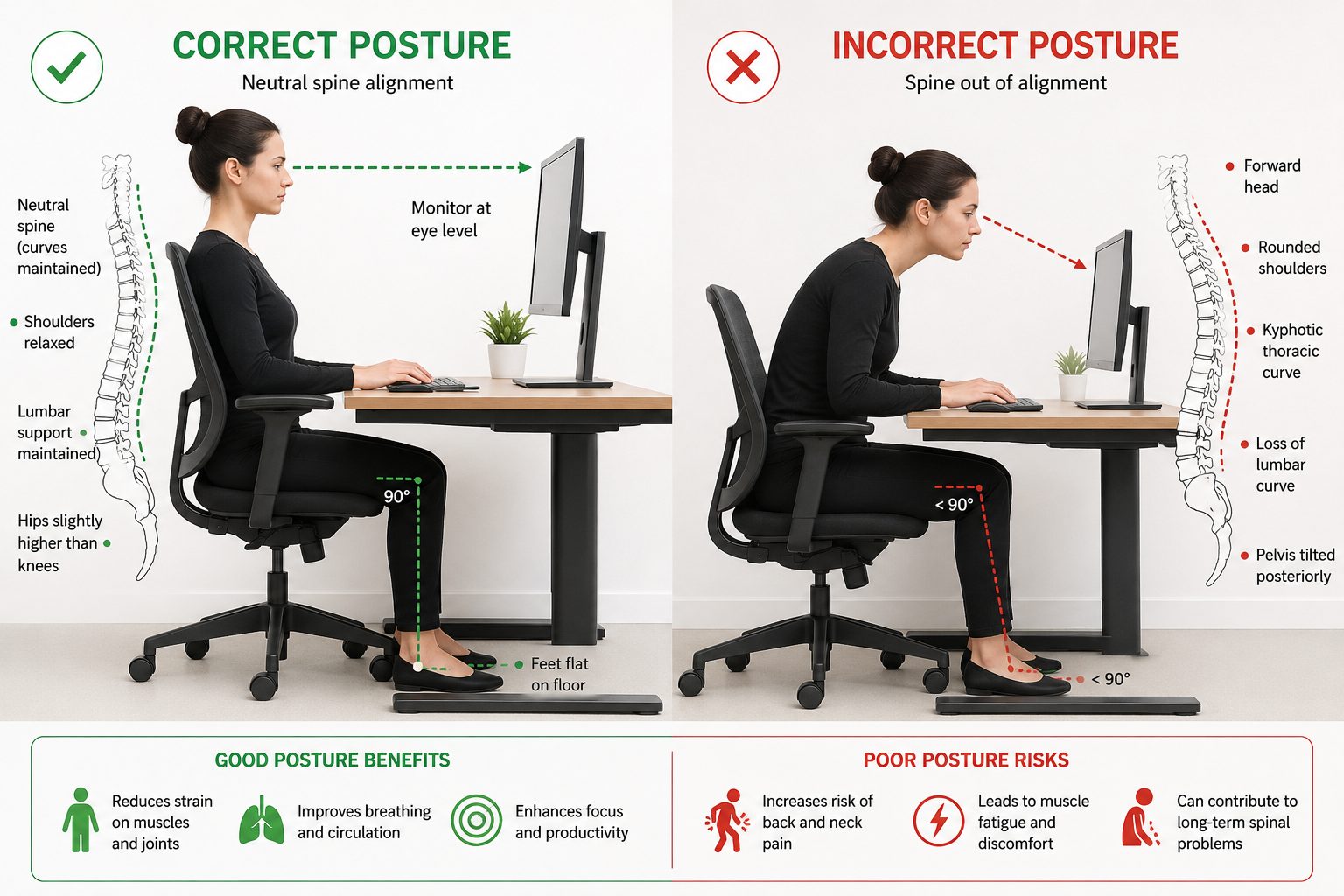
The result? Over months and years, you end up with degenerative disc disease, facet joint arthritis, and a condition called flat back syndrome, where the natural lumbar curve is lost. Many patients are surprised to learn that their pain didn’t come from lifting a heavy box. It came from sitting at a desk for years.
What Happens to Your Discs
Think of your intervertebral discs like water-filled sponges. When you move, they absorb and release fluid, helping them stay hydrated and resilient. When you are stationary for hours at a time, fluid is slowly squeezed out, and the disc loses its shock-absorbing capacity. Over time, this desiccation accelerates degeneration. This is not just theoretical. MRI studies consistently show higher rates of disc degeneration in sedentary workers compared to more physically active populations.
Prolonged sitting also tightens the hip flexors and weakens the gluteal muscles, which shifts more load onto the lumbar spine. This imbalance is what is known as a kinetic chain failure; the whole system breaks down, not just one part.
What You Can Do Right Now
The good news is that small, consistent changes make a real difference. Here are my practical recommendations:
- Stand, stretch, or walk for at least 2 minutes every 20 minutes of sitting.
- Optimize your workstation: Your monitor should be at eye level. Your chair should support the lumbar curve. Feet flat on the floor, hips at approximately 90 degrees.
- Strengthen your core: A strong core helps relieve stress on the discs. Exercises like bird-dog, dead bug, and pelvic tilts are excellent starting points.
- Stretch your hip flexors daily: A simple lunge stretch held for 30 seconds on each side can significantly reduce low back tension.
- Consider a standing desk: Alternating between sitting and standing throughout the day is far better than either alone.
I often tell my patients: the best position for your spine is the next position. Variety of movement is the key. You don’t need to overhaul your entire lifestyle; just interrupt your sitting more often than you think you need to.
When to Seek Evaluation
If you are experiencing persistent low back pain that radiates into your buttocks or legs, numbness or tingling in the lower extremities, or pain that wakes you at night, those are signals that warrant a professional evaluation. Many spinal conditions will improve with time and patience, but some may benefit from an evaluation and a plan.
Knowledge is power. The more you understand how your spine works and the signs that require attention, the more peace of mind you will have. That peace of mind might just be what you need to start improving. Until next time, this is Dr. Shim.
References
- Nachemson A. The load on lumbar disks in different positions of the body. Clin Orthop Relat Res. 1966;45:107–122.
- Wilke HJ, Neef P, Caimi M, Hoogland T, Claes LE. New in vivo measurements of pressures in the intervertebral disc in daily life. Spine. 1999;24(8):755–762.
- Hartvigsen J, Hancock MJ, Kongsted A, et al. What low back pain is and why we need to pay attention. Lancet. 2018;391(10137):2356–2367.
- Roffey DM, Wai EK, Bishop P, et al. Causal assessment of awkward occupational postures and low back pain. Spine J. 2010;10(1):89–99.
- Shim JH. Text Neck and Forward Head Posture. ShimSpine.com. May 21, 2021. https://www.shimspine.com/text-neck-and-forward-head-posture/
Disclosure: The information provided is for educational purposes only and does not constitute medical advice. Always consult a qualified healthcare provider for diagnosis and treatment.
Last modified: June 26, 2026