The First 30 Days: Medical and Legal Timelines After a Spine Injury Car Accident
Today, I want to talk about something that comes up constantly in my practice: what actually happens, medically and legally, in the first month after a car accident causes a spine injury. Patients and attorneys alike often focus on the eventual claim or lawsuit, but the early weeks set the foundation for everything that follows. This post walks through that timeline factually, without taking a side.
The Initial Medical Window
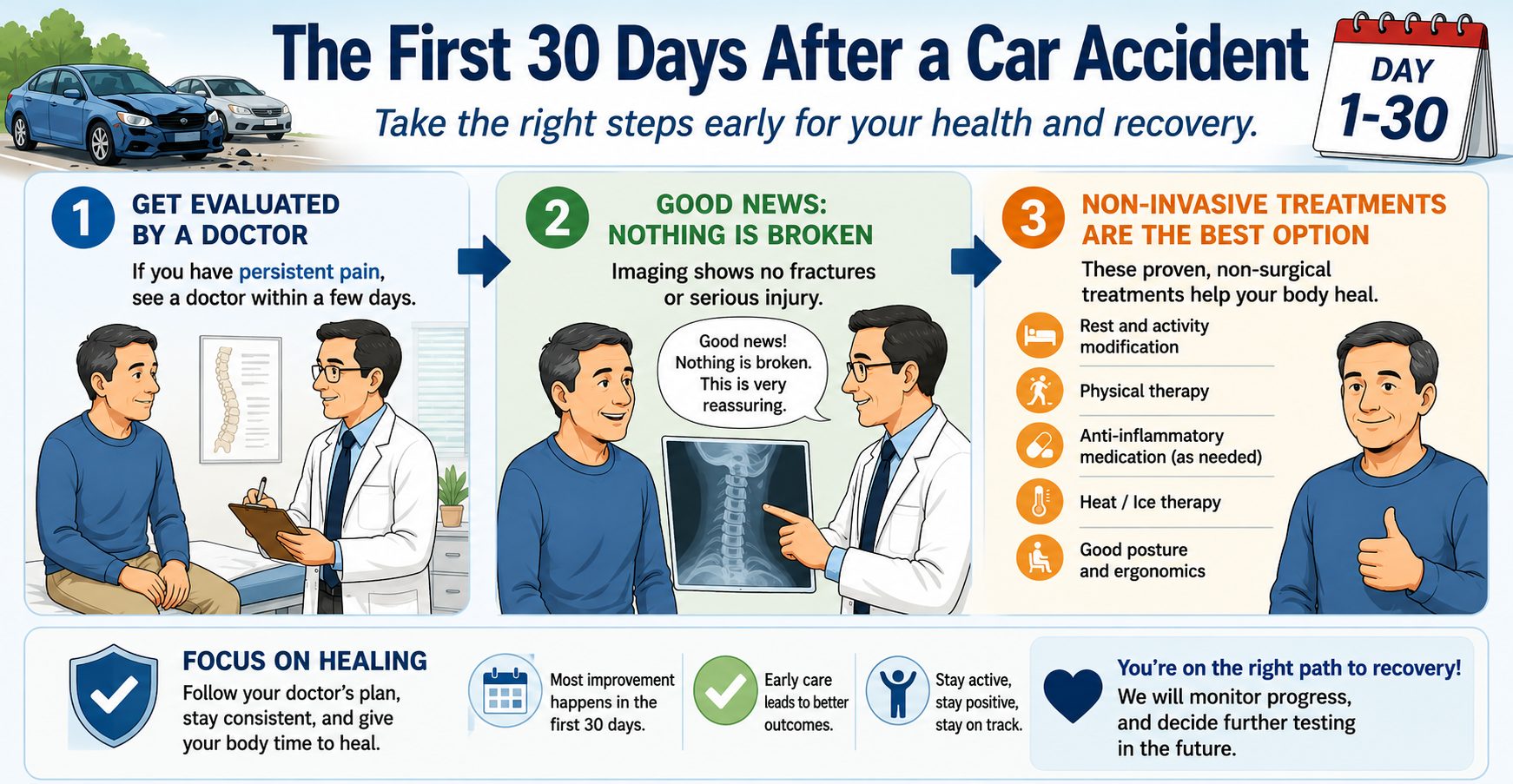
In Florida, Personal Injury Protection (PIP) coverage generally requires that an injured person seek initial medical treatment within 14 days of the accident to remain eligible for no-fault benefits. This is a procedural requirement, not a clinical one. The symptoms from soft-tissue injuries, including cervical and lumbar strains, can worsen over days rather than appearing immediately. Regardless of jurisdiction, prompt evaluation within this early window creates a contemporaneous medical record that later becomes important to both treating physicians and any reviewing party.
Building the Medical Record
Initial visits to the walk in clinic or the family physician typically focus on ruling out fracture or neurologic compromise, often through physical examination and, when indicated, plain radiographs or CT. In cases of profound weakness and loss of the ability to control the bladder and bowels, ER evaluations should be immediate. If severe pain, persistent weakness, and focal numbness persists beyond a few weeks of conservative care, referral to a spine specialist and advanced imaging such as MRI may follow. Each step, ER visit, urgent care visit, primary care follow-up, specialist consultation, imaging report, becomes part of a continuous record. Gaps in this timeline, whether from missed appointments or delayed referrals, are frequently scrutinized later, so consistency in care matters as much as the care itself.
Insurance Timelines and Their Practical Effect
Insurers operate on their own statutory and contractual clocks, PIP claims, for example, must generally be paid or denied within a set number of days after receipt of a bill, and medical examinations may be requested if treatment continues past initial expectations. These timelines run independently of how a patient is actually healing, which is why ongoing communication between treating providers and claims adjusters, when authorized, helps keep care and coverage aligned.
When Symptoms Persist Beyond the First Month
Most whiplash-associated and soft-tissue injuries improve substantially within four to six weeks. When severe pain, objective radiculopathy, or functional limitation persists beyond that point, it typically prompts a shift from acute management toward a more structured diagnostic workup. This transition is a natural medical decision point, independent of the cause of the complaints. As we age, degenerative spines, like all wear and tear, simply take longer to settle after trauma in some individuals than others. The pattern of the pain, the severity, the quality, and the percentage of presence all become considerations used by physicians when recommending diagnostic and treatment options.
Looking Ahead
Statutes of limitation for personal injury claims vary by state and circumstance, and they begin running from the date of the accident regardless of how treatment is progressing. Patients and their legal representatives benefit from understanding this early, since it affects decisions about when to finalize treatment or seek additional opinions. Whether you are a patient navigating recovery or a professional evaluating a claim, an accurate, well-documented medical timeline remains the most reliable foundation for a fair outcome.
Until next time, this is Dr. Shim.
References
Elliott JM, Walton DM, Albin SR, et al. Biopsychosocial sequelae and recovery trajectories from whiplash injury following a motor vehicle collision. Spine J. 2023;23(7):1028–1036. doi:10.1016/j.spinee.2023.03.005. PMID: 36958668
Kent R, Cormier J, McMurry TL, et al. Spinal injury rates and specific causation in motor vehicle collisions. Accid Anal Prev. 2023;186:107047. doi:10.1016/j.aap.2023.107047
Florida Department of Highway Safety and Motor Vehicles. Personal Injury Protection (PIP) Insurance Requirements. Florida Statutes §627.736. Updated 2024.
Carroll LJ, Holm LW, Hogg-Johnson S, et al. Course and prognostic factors for neck pain in whiplash-associated disorders: results of the Bone and Joint Decade 2000–2010 Task Force on Neck Pain and Its Associated Disorders. Spine. 2008;33(4S):S83–S92. doi:10.1097/BRS.0b013e3181643eb8
National Highway Traffic Safety Administration. Traffic Safety Facts: Whiplash and Neck Injury Data. NHTSA Report DOT HS 813 XXX. 2023.
Disclosure: This blog is for general educational and informational purposes only. It does not constitute legal or medical advice. Dr. Shim provides opinions as an experienced orthopaedic spine surgeon with medical-legal expertise since 1994. This content is presented without bias toward plaintiff or defendant interests. ShimSpine.com is self-funded and accepts no paid advertising.
Last modified: June 22, 2026