The CME Physician: A Voice for Objectivity, Resolution, and Healing
By John H. Shim, MD | Board-Certified Orthopaedic Spine Surgeon
In personal injury litigation, few roles are more misunderstood than that of the physician who performs a Compulsory Medical Evaluation (CME). Critics have worked hard to portray these physicians as partisan advocates for the defense, paid to minimize and deny. Having performed hundreds of these evaluations over my career as a board-certified orthopaedic spine surgeon, I can tell you that characterization could not be further from the truth. When done with rigor and integrity, the CME physician may be the most valuable and most constructive participant in the entire litigation process.
What a CME Actually Is
A CME exists for a legitimate and constitutionally grounded reason: when a person places their physical condition at issue in a lawsuit, the defendant has a right to an independent medical assessment. That is not adversarial, it is fairness. The CME physician’s responsibility is to examine the claimant, review the medical records, and render objective opinions that can be presented at trial.
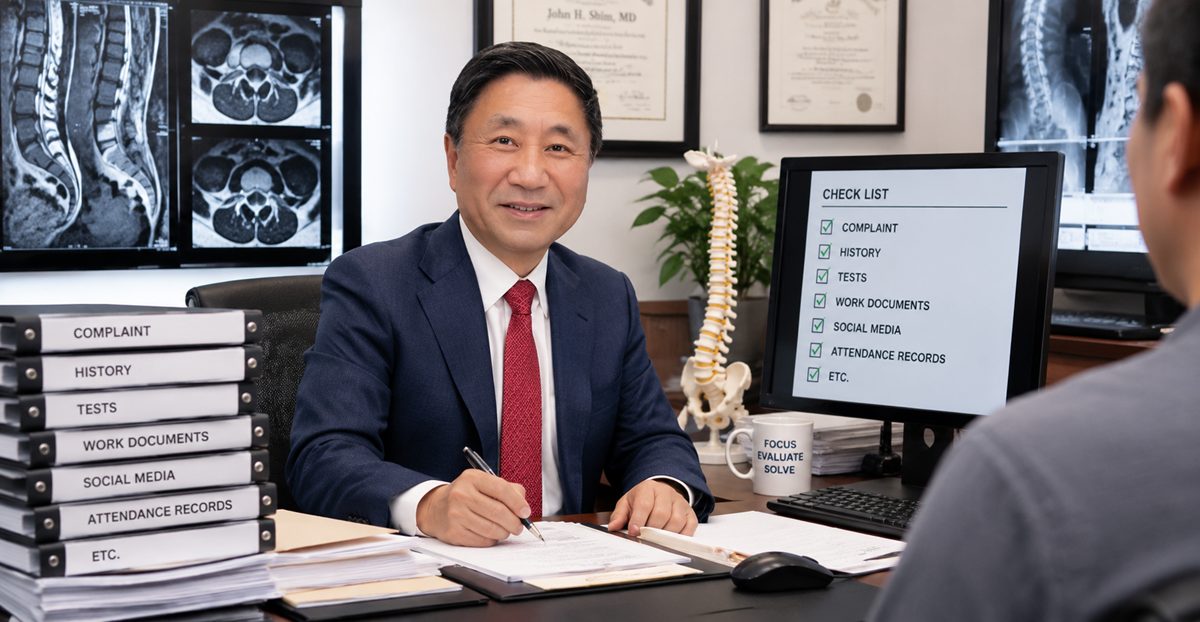
What distinguishes a rigorous CME from a cursory one is scope. I do not simply review recent treatment records and render a quick opinion. I examine the claimant’s entire medical history; records predating the accident, imaging studies, surgical notes, therapy logs, and all post-event documentation. I examine the claimant in person, recording both subjective complaints and objective findings. I then correlate the medical data with workplace records, functional assessments, and, when available, social media activity and other evidence of real-world life function. This comprehensive picture is something the treating physician rarely has.
The Objectivity Advantage
Treating physicians are advocates by nature. They hear what the patient reports, treat the complaint, and, understandably, document within that framework. There is nothing wrong with that. But it creates an inherent limitation in litigation: the treating doctor knows only what the patient has chosen to share.
The CME physician operates differently. I have no therapeutic relationship and no financial stake in the claimant’s ongoing treatment. My obligation is to the totality of the medical record. When I identify pre-existing degeneration, prior complaints documented in unrelated records, or a disconnect between reported disability and demonstrated real-world function, I say so. That is not advocacy for the defense. That is medicine practiced at its most complete.
A Bridge to Resolution
Here is where I think conventional wisdom breaks down most completely. I do not view my role as an instrument of denial. I view it as a mechanism for resolution. A thorough, honest CME report, one that acknowledges genuine injuries while providing context around causation, pre-existing conditions, and realistic prognosis, gives both sides the information they need to reach a fair settlement.
Plaintiffs and their attorneys deserve a realistic assessment of what a claim is actually worth. Inflated expectations lead to prolonged litigation, mounting legal fees, and the psychological toll of years spent in the adversarial process. When I provide an objective evaluation, I give the plaintiff’s team the clearest possible picture of how their case will appear to a jury. That information has value not just for the defense but also for the injured person, who deserves closure and the ability to move forward.
Litigation is painful. It delays healing, literally and figuratively. The uncertainty, the depositions, the years of waiting erode quality of life. A well-reasoned CME that helps parties reach a fair resolution is, in the deepest sense, a service to the claimant. That is the standard I hold myself to, and the standard every CME physician should aspire to meet.
Dr. John H. Shim is a board-certified orthopaedic spine surgeon and founder of Shimspine, a medical-legal office that provides comprehensive CME services, records review, and litigation support in Florida and nationally.
Last modified: June 11, 2026