Summer Sports and Your Spine: What Pickleball, Golf, and Swimming Can Do to Your Back
Today, I want to talk about something I see a lot more of during the summer months: spine injuries from popular warm-weather sports. Whether you are out on the pickleball court, the golf course, or the pool, these activities can place significant stress on your spine. That does not mean you should avoid them. Far from it. Staying active is one of the best things you can do for your back. But it does mean you need to understand the risks and play smart.
Pickleball: The Fastest-Growing Sport and Its Hidden Spine Risks
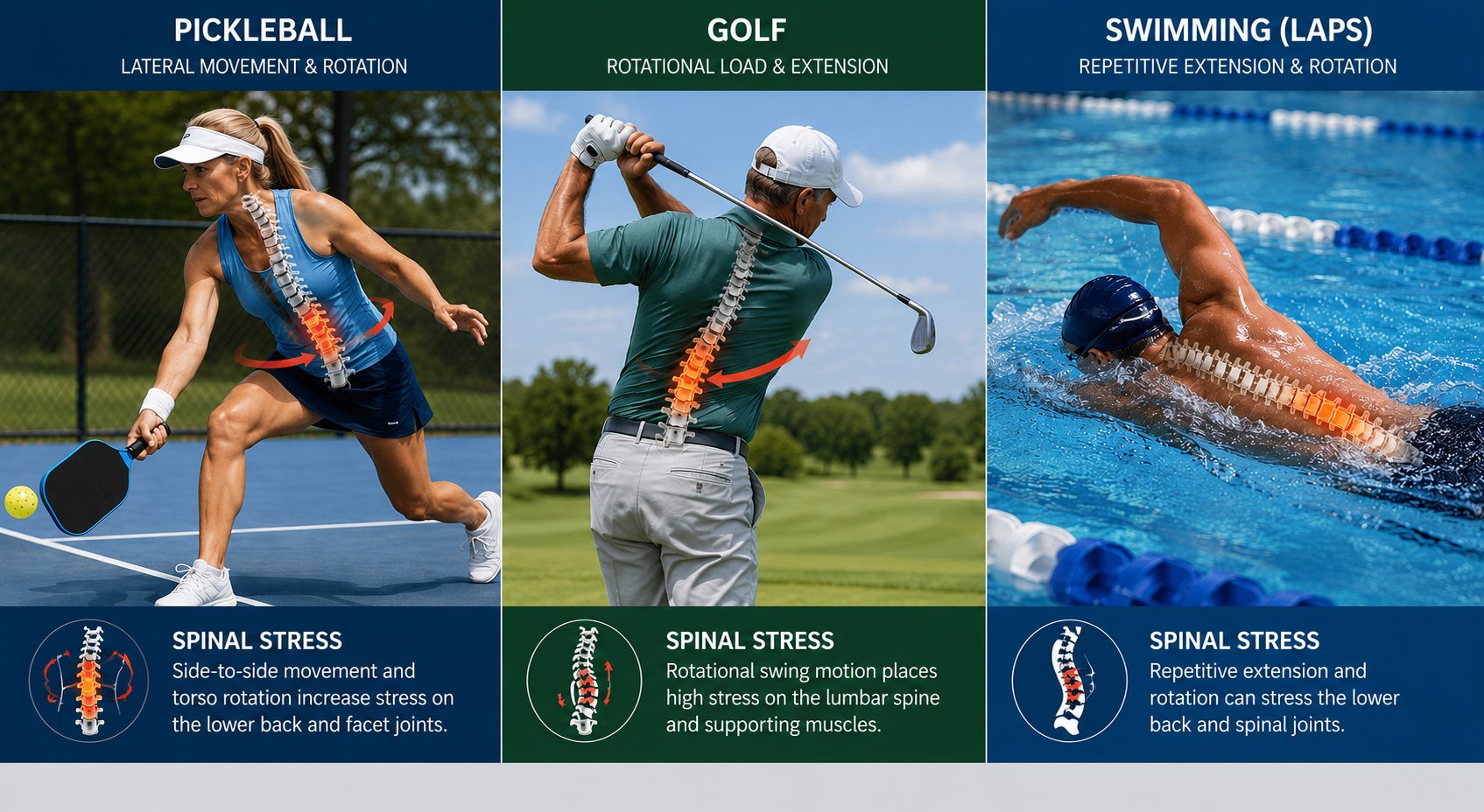
Pickleball has exploded in popularity, especially here in Florida, and I have seen a corresponding rise in patients coming in with back pain linked to it. The sport involves quick pivoting, lunging, and overhead striking, all of which stress the lumbar spine, sacroiliac joints, and thoracic region. This is compounded by the fact that many players are over 50 and may have some pre-existing disc degeneration.
Rapid direction changes put torsional load on the spine, and uneven court surfaces or improper footwear amplify this stress. A 2021 survey published in the American Journal of Preventive Medicine noted a sharp rise in pickleball-related injuries among older adults, with musculoskeletal injuries making up the majority.
Golf: Rotation Is a Double-Edged Sword
Golf is often seen as low-impact, but the golf swing is one of the most biomechanically complex motions the human spine performs. At ball contact, lumbar compressive forces can reach up to eight times body weight, according to research published in the American Journal of Sports Medicine. The rotational mechanics of a full swing create significant shear and torsional forces on the lumbar discs and facet joints.
Common golf-related spine injuries include lumbar disc herniations, facet syndrome, and paraspinal muscle strains. Repetitive swinging without proper core engagement or technique can accelerate degenerative changes in the lumbar spine over time.
Swimming: Generally Safe, but Not Without Risk
Swimming is frequently recommended by spine surgeons, and for good reason. Water buoyancy offloads compressive forces on the spine while providing excellent cardiovascular and muscular conditioning. However, the butterfly and breaststroke involve significant lumbar hyperextension and can aggravate lumbar stenosis or spondylolisthesis.
Freestyle and backstroke are generally the most spine-friendly options. Flip turns can also create a burst of axial load and flexion that may irritate existing disc pathology. For patients swimming for therapeutic purposes, I typically recommend freestyle with a pull buoy to keep the body horizontal without excessive lumbar movement.
Practical Tips to Protect Your Spine This Summer
- Warm up before every session. Five to ten minutes of walking and dynamic stretching prepares the paraspinal muscles and reduces injury risk.
- Strengthen your core consistently. A strong deep core, including the transversus abdominis and multifidus, is your best defense against spine injuries in all three sports.
- Use proper technique. Poor mechanics are the number one modifiable risk factor. Consider lessons from a coach, even if you are an experienced player.
- Do not play through pain. Sharp or radiating pain during activity is a warning sign, not something to push through.
- Cool down and stretch. Gentle lumbar flexion and hip flexor stretches after activity help restore normal muscle tone.
When to See a Doctor
If you develop back pain that radiates down one or both legs, is associated with weakness or numbness, or persists beyond a few days despite rest and over-the-counter anti-inflammatories, it is time to get evaluated. These symptoms may suggest disc herniation, nerve root compression, or another structural issue that warrants imaging and a clinical assessment. Do not wait until the end of the summer season; early intervention usually means better outcomes.
Until next time, this is Dr. Shim.
References
- Forrester MB. Pickleball-related injuries treated in emergency departments, United States, 2016-2020. Am J Prev Med. 2021;61(2):295-298.
- Hosea TM, Gatt CJ. Back pain in golf. Clin Sports Med. 1996;15(1):37-53.
- Lindsay DM, Vandervoort AA. Golf-related low back pain: a review of causative factors and prevention strategies. Asian J Sports Med. 2014;5(4):e24289.
- Wanivenhaus F, Fox AJ, Chaudhury S, Rodeo SA. Epidemiology of injuries and prevention strategies in competitive swimmers. Sports Health. 2012;4(3):246-251.
- Bono CM. Low-back pain in athletes. J Bone Joint Surg Am. 2004;86(2):382-396.
Disclosure: This blog is intended for general educational purposes only and does not constitute medical advice. Always consult a qualified spine specialist before beginning or modifying any physical activity, especially if you have a known spinal condition. Dr. John H. Shim, MD is a board-certified orthopaedic spine surgeon serving the Tampa Bay area since 1993.
Last modified: June 1, 2026